
Evalion Workflow
Workflow
The Evalion workflow follows a continuous cycle of improvement, helping you and your team enhance your AI Conversational Agents. This iterative approach ensures that your agent performs reliably in production and continues to improve over time.
This continuous workflow provides massive acceleration, enabling you to experiment without fear, allowing you and your team to focus on activities such as orchestration and building a robust, generative conversational architecture.
The workflow cycle consists of three main phases: test, iterate, and re-test.
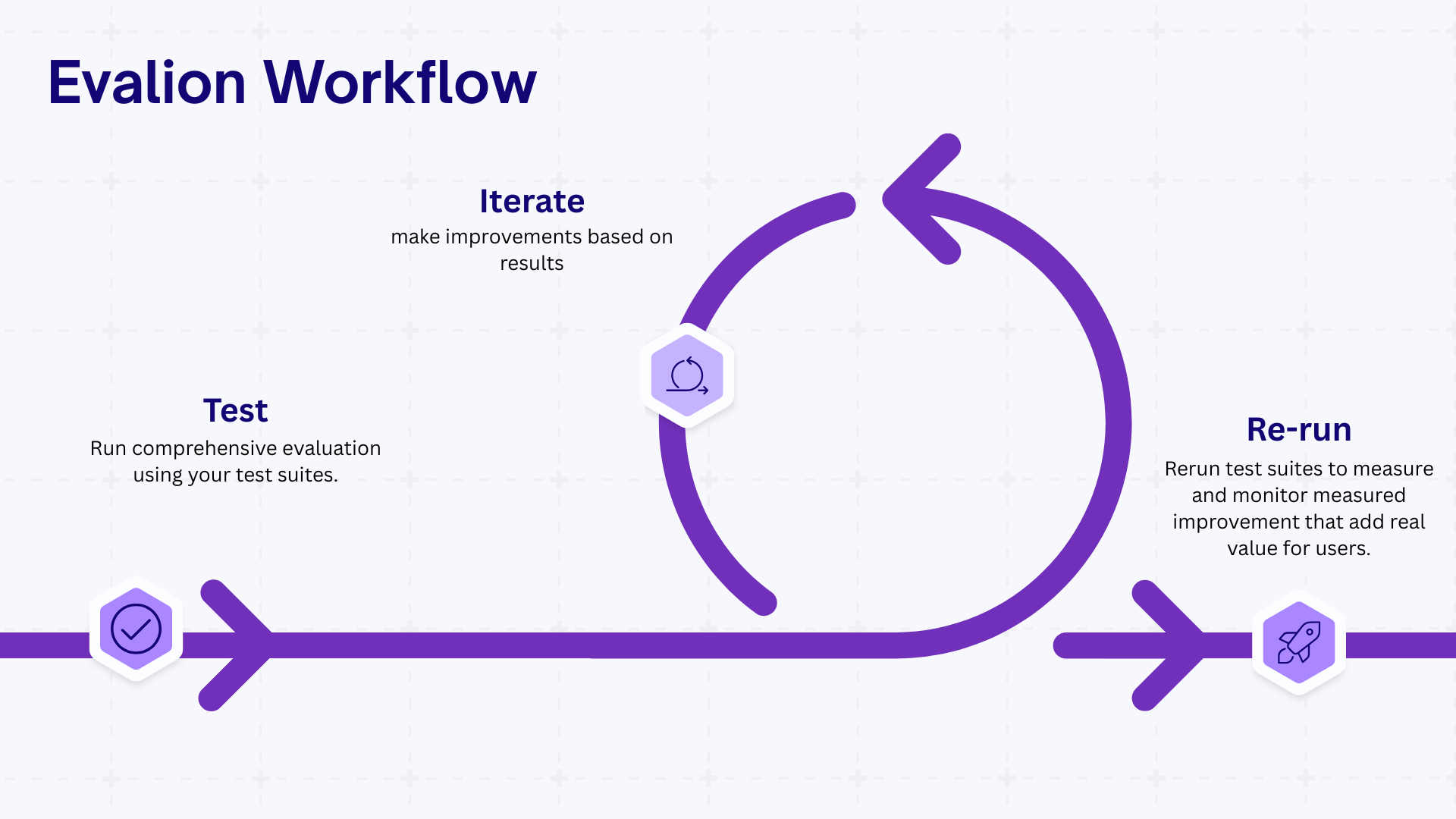
1. Test: Establish Your Baseline
Your testing phase creates the foundation for all improvements by providing key objective data about your agent's current performance. This isn't just about finding problems; it's about understanding your agent's behavioral patterns, identifying edge cases, and establishing measurable benchmarks that will guide your optimization efforts.
In this phase, Evalion helps you establish the baseline for your AI conversational agent by helping you:
- Run comprehensive evaluations using your test suites.
- Gather performance data across scenarios and personas.
- Identify strengths and weaknesses in agent behavior.
- Document specific failure points and success patterns.
2. Iterate: Make Targeted Improvements
The iteration phase transforms your test results into concrete and measurable improvements. Rather than making random changes, you'll use data-driven decisions to prioritize the most impactful fixes first. This approach ensures each change addresses real user problems while eradicating the risk of introducing new issues.
In this phase, Evalion helps you and your team:
- Analyze test results to prioritize fixes.
- Update prompts, configurations, or training data.
- Refine scenarios based on discovered edge cases.
- Adjust metrics and success criteria as needed.
- Introduce new personas for customer-facing use cases.
3. Re-test: Validate and Monitor Your Changes
Re-testing and monitoring close the loop by proving your improvements actually work. This validation phase ensures that your changes solve the intended problems without introducing new ones, providing you with the confidence to either deploy your improvements or continue iterating based on the new results.
During this phase, you can accelerate your conversational AI development cycle by:
- Running the same test suites to measure improvement.
- Comparing results against previous test baselines.
- Ensuring fixes don't introduce new issues.
- Deciding whether to deploy or continue iterating.
Updated about 2 months ago